Monastic clothing. Costumes of Religious Orders. Clothing of Franciscan Brothers, monks in 1870, 19th century.
Published 1870, Munich. Münchener Bilderbogen.
The Benedictine (Latin Ordo Sancti Benedict, OSB) are a contemplative order of aligned within the Roman Catholic Church. Also in Anglicanism and Lutheranism few Benedictine monasteries have been preserved. It is named after its founder, St. Benedict of Nursia, and is the oldest Order of western religious life.
Published 1870, Munich. Münchener Bilderbogen.
The Dominican nuns, religious abbreviation OP, Latin Ordo praedicatorum (as the Dominicans, the male branch) are a Roman Catholic religious order, which began with a foundation by the Spanish priest Saint Dominic de Guzman in 1205 and approved by Pope Honorius III on 22 December 1216.
First order, the Dominicans are referred to as Second Order, the contemplative Dominican designated exam and as the Third Order Dominicans who are without precedence even charitable, educational, nursing or missionary work. In France, the Dominicans were known as Jacobins, because their convent in Paris was attached to the church of Saint Jacques.
Society of St. Ursula (Compagnia di Sant’Orsola), Latin Ordo Sanctae Ursula. Founded in 1535 by Angela Merici in Brescia in honor of Saint Ursula of Cologne. Originally, the members lived by the evangelical counsels of poverty, chastity and obedience, but without public vows.
Published 1870, Munich. Münchener Bilderbogen.
Monastic clothing, Ordo Sancti Benedicti. Nuns of Benedictine in the 18th century.
The Benedictine woman monasteries were founded, according to the legend, by St. Scholastica
the twin sister of St. Benedict of Nursia, in the 6th century.
Published 1870, Munich. Münchener Bilderbogen.
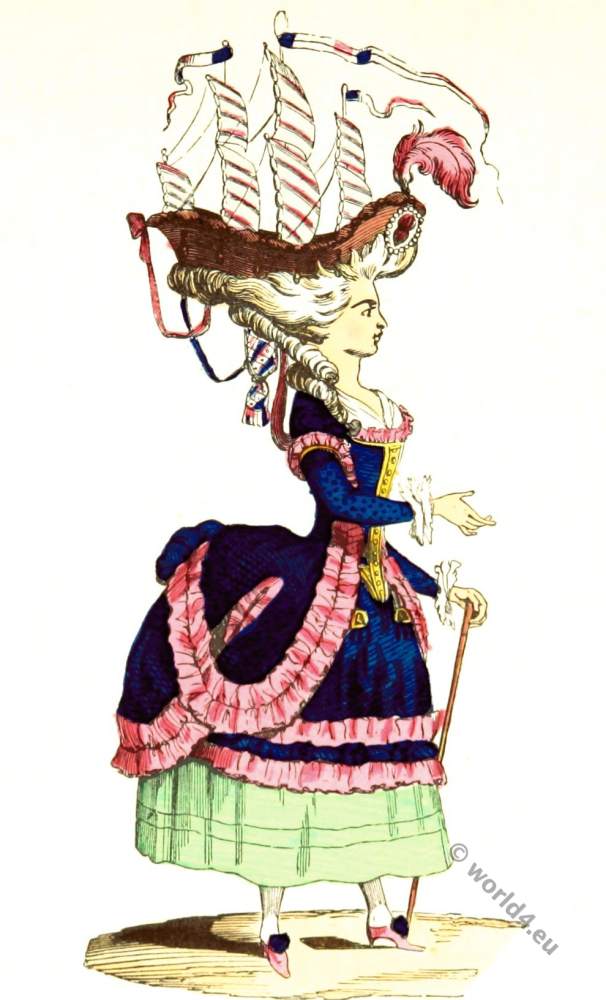
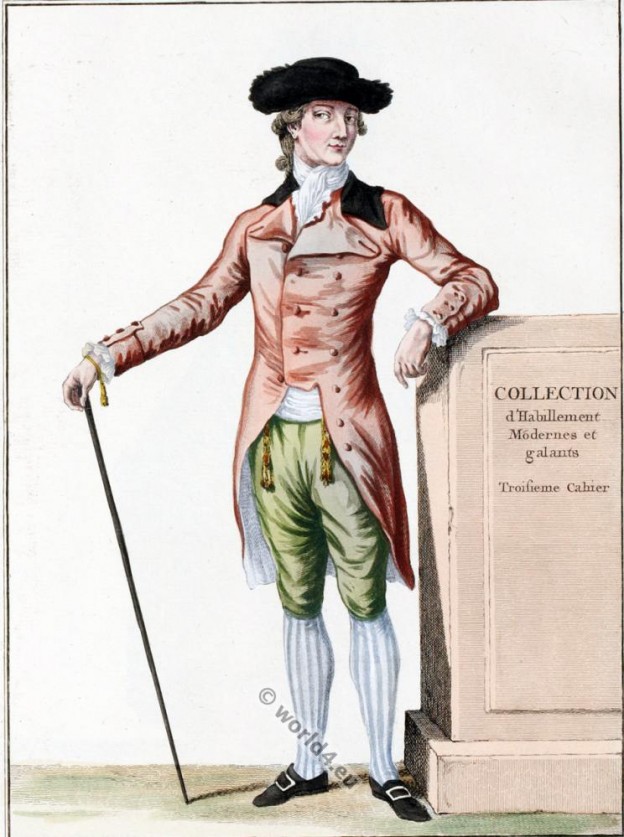
Peasant dress is universal – “Fashion “à la Marlborough”- Caps - Bonnets – Mdlles. Fredin and Quentin – Ruches – Low bodices; ”postiches” – Costume of Contat · Suzanne – Fashions “à la Figaro” - Literature and politics signified in dress; the Princess de Monaco’s pouf - Pouf “à la circonstance;” the “inoculation” pouf – The “innocence made manifest” caraco - The “harpy “costume – Coats, cravats, and waistcoats, Sailor jackets and” pierrots” – Déshabilles; “the lying fichu” - Etiquette in dress Seasonable costumes – The queen’s card·table – State of trade in Paris, circa 1787 - ”Pinceauteuses,” or female colorers.
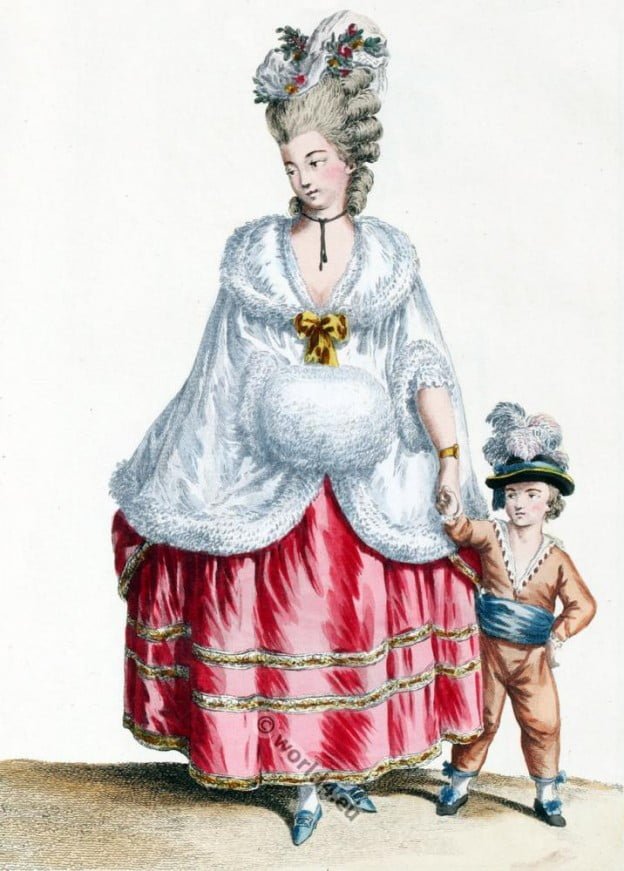
The influence of Marie Antoinette on fashion – Letter from Maria Theresa – Leonard and Mdlle. Bertin – Various styles of head-dresses – “Pouf” – “ The Journal de Paris” – Reign of Louis XVI. – Male and female hairdressers -Plumes – Hair worn low – The queen’s “puce ” – colored gown; shades of color in dresses – Oberkampf and the Jouy prints – Expensive satins- Trimmings, their great number and importance – Gauze, blond, tulle, and ribbons – Some kinds of shoes – Venez-y-Voir – The “Archduchess” ribbons – A dress worn at the opera.
WE have now reached the reign of Louis XVI., when Marie Antoinette was holding her court. She had already begun to set the fashion when only Dauphiness. One day, in 1775, the new queen took up from her dressing-table two peacock feathers, and placed them with several little ostrich plumes in her hair. Louis XVI. came in, and greatly admired his wife, saying he had never seen her look so well. Almost immediately feathers came into fashion, not in France only, but throughout Europe. But when; shortly afterwards, Marie Antoinette sent a portrait of herself, wearing large feathers as a head-dress, to her mother, the Empress Maria Theresa returned it. “There has been, no doubt, some mistake,” wrote Maria Theresa; “I received the portrait of an actress, not that of a queen; I am expecting the right one.”